

This is my final background article before we really start cooking. I’m writing here explicitly for newbies who have never spent much time in the kitchen and who are wisely nervous of confined spaces featuring sharp blades, boiling oil and hissing steam.
The kitchen is by far the most dangerous room in the house for general accidents, although bathrooms slips-and-falls are responsible for more ER visits. Statistically, the most deadly room in the house is the bedroom, followed by the lounge. You’re much more likely to die in the bedroom than the kitchen. However, the kitchen is by far the #1 cause of household fires.
So if you want a long life, stay in the kitchen and tend the flame. Let’s avoid the cuts, burns and scalds, let’s make sure we never slip in the scullery. There is one very special aspect to unemployed cooking: you are not generally in a hurry. You are not serving 520 entrées simultaneously at a banquet with a team of Ecuadorean cooks working to rule. You are your own Ecuadorean cook, you do things in your own time, the same way you know, every time. Consistency is everything in cooking. You need to develop your own systems for your kitchen, turn these systems into routines, then into rituals, then back into routines again, so that you can run on automatic pilot with full and immediate attention if there’s any problem.
Looking at the situation coldly, if you’ve been living on prepared food up until now and are contemplating cooking for yourself for the first time, I know exactly where I would start. I would go and buy a really good can-opener. Never sneer at canned tomatoes from Italy, for one thing, a single can can carry you across three meals. We had an emergency can of tinned peaches I opened the other day, they had expired and they were delicious.
Canned food is picked when it’s at its peak ripeness, it’s often nearly as good as fresh produce in food value. I’ve gone through extended periods where I used no cans at all but that was quite a luxury. I always try to have a can of baked beans as an emergency backup. Beans on toast is extreme comfort food for me.
A can-opener and a spoon and you are on your way, mark my words. One thing about unemployed cooking, this is survival level, you are not competing with the pretty pictures on Instagram.
The third item I would get is an abrasive kitchen sponge to clean the spoon. When I was a kid there was a brand called Spunz, pronounced the German way, I can’t find any trace of it now. I’ve always thought the spunz was one of the great advances in kitchen technology.
This is a fact you should factor into your cooking right from the beginning: cooking entails and includes cleaning up, there’s no way around it. There’s only one further thing you need to brand in your brain in this respect: the longer you leave it, the worse it gets. If you’ve drained some rice noodles in a colander and you clean it straight away, there’s no problem at all. If you leave it for a few days, those noodles stick as though they’ve been superglued and you have a major task on your hands.
So learn to clean up as you go, right from the start. Future you will thank present you when they come into the kitchen and find a rack of spotless dishes and pots.
The way I work, I generally recycle things straight from the rack back into the action. However, there is a place for everything in the cupboards and when I’ve done a big clean-up I do manage to put the pots where they belong. When sharing the kitchen, this led to the fairly frequent complaint, “How on earth do you expect me to find things when you keep putting them in the right place?”
Right now I have a very small kitchen, I call it the galley, a big change from my old place, where the person who designed the house was a professional chef. It was our dining room and main living room as well.
My present kitchen has very good cupboards; however, they are exactly at head height, so I’ve taken a few skull injuries here. I bend down to get something out of the lower cupboard and then stand up. The kitchen is seriously the realm in which to get into good habits. Shut the cupboard doors. Tighten lids properly — I was reminded for decades about a bottle of Nescafé that got broken when I didn’t tighten the lid. It was a good lesson to learn. There’s nothing more disheartening in the middle of a cook than to break a bottle of something sticky and having to clean up goo and shards of glass in a hurry. Just don’t do it.
And don’t spill water on the floor, it’s difficult but very important. You cannot afford to slip in the kitchen. I have a single cylinder gas cooker on a bar stool, if I bump it, it’s a disaster. If you do spill water, immediately put newspaper down so you can see the extent and avoid any immediate slippage.
We come now to the vexed question of knives. For years I had a genuine French Sabatier carbon steel knife I bought in London in 1978. It really would slice a piece of paper under its own weight. I sharpened it myself. I gave it away when I went overseas in 1987.
I went on a hunt for a replacement around 2012. The nearest big shopping centre for us in Eswatini is the city of Mbombela, formerly Nelspruit. I found The Knife Shop in one of the malls, this guy had Japanese knives that were themselves as thin as a piece of paper.
However, he had the whole range of Victorinox kitchen knives in all colours. He said his wife could choose any knife in the world she wanted and she only used the Victorinoxes. That was good enough for me. I bought three Victorinoxes and a very nice Wüsthof Gourmet kitchen knife for heavier stuff. Just about all my chopping for the last ten years has been done with a small, sharp-ended Victorinox. You can’t sharpen these blades, it’s just amazing how they keep their edge.
The chopped red onions of my icon picture were an everyday cut with the small Victorinox. This is quite fine enough for me.
I also have a ceramic knife that I’ve become very attached to, again, you can’t sharpen it. I read that chopped lettuce doesn’t go brown so quickly if you use a ceramic knife. Now, I’m a great fan of chopped lettuce. You can put some in a bowl of hot rice with a splash of soy sauce and create something instantly. But the lettuce does go brown very fast, even if you put a bit of lemon on it.
I did a quick test one day with some spinach stalks. This is a real unemployed-on-the-street story, so bear with me. Vegetarian street food of any kind is hard to find in Johannesburg but there are pie stalls that sell spinach and feta pies, the only remotely vegetarian option. These have a very distinctive spinach flavour and it was only on experimentation that I found this comes from the stalks of the spinach, which they clearly use in bulk in their pies.
So I really like the spinach stalk flavour, it has all the best connotations for me of something warm to eat on a cold day on the street.
I did the test fairly systematically, chopping small piles alternately with each knife so there was no significant time difference. You can see that the stalks chopped with the metal knife are quite a bit browner. Unfortunately for some reason the sample was not balanced in terms of greenery. I’ll do this again properly some day, but for me, this is enough proof. I do a lot of chopping of fresh herbs when I can, coriander, basil, sage. I always use the ceramic knife and chop really fine, it makes a huge difference.
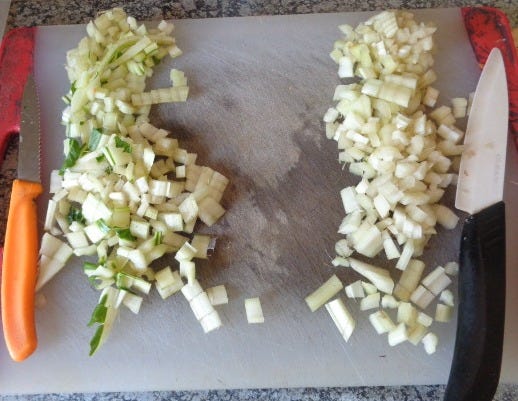
Anyway, that’s the cheerful little orange knife with which I do nearly all my chopping. Really, nothing fancy is needed.
I’ve said before and will say again, the single most time-consuming task for me in the kitchen, but also the most rewarding one, is cleaning fresh herbs. I always wash them very thoroughly and clean out all the stalks. Then I chop them really fine. Yellow lentils just with fresh coriander stirred in quite late is one of the best dishes I make. Fry some thinly sliced garlic until it’s just going brown, chuck it on top for a last sizzle, and you have a tarka dhal to match anything from north London to north Punjab.
Much of your life as a vegan cook is just chopping, so it’s worth getting well set up to do it. In Japan, the sushi chef is known as itamae, the person behind the chopping board. That’s you.
As far as chopping technique goes, I was taught how to hold a vegetable and cut away from my fingers by a guy who had been a cook in the South African army. He was amazed that I thought I knew how to cook and didn’t know how to chop a carrot. It was a very good lesson.
If you want an excellent example of how to do it, watch Mr Miyagi giving a lecture to the boy about to take The Next Karate Kid, Hilary Swank, to the prom. The boy enters while Miyagi is sharpening his knife. Look carefully at how he holds the marrow and slices away from his fingers, his technique is impeccable. This way, he doesn’t even have to look at his fingers while he chops. He looks straight at the boy while slicing menacingly.
The general principle is always to make sure you are cutting away from yourself. This especially applies to anything with a tough skin, even a tomato. The last time I cut myself was when my knife slipped on a wet tomato. I was given a new, larger, very sharp Victorinox for my birthday in February and it caught me by surprise. There was blood.
I had a girlfriend, an architect with a penchant for handling all kinds of tools up to lathes, welding and brazing. She always said “You only cut yourself with a blunt knife” if there was an accident with my Sabatier. I have to say, it’s not true. Sharp knives are dangerous, make no mistake. But equally, blunt knives are really dangerous.
You can hold a potato in your hand and peel it by cutting towards your palm, if you know what you’re doing. Just in general, look at the way you’re cutting and make sure that however the knife might slip, or just go straight through what you’re slicing, your hand is nowhere in line where that knife may go.
Again, these are habits. Habits are a fascinating thing to study in themselves, so discipline in the kitchen is a really good way to get to terms with your own personality traits. Practise cooking as genuine self development, growth.
And this brings us to a difficult but important subject, a great and universal moral drama.
There is a vast existential war going on in every kitchen, the war of the Packaging Bastards versus all of humanity and the entire planet. There’s a very essential implement you need to fight this war, I would actually rate it as more important than your first knife. This is a really good pair of kitchen scissors.
As far as I can tell, there was a major conference of the Packaging Bastards around the early 1950s. They swore a secret war on all of us. Why they hate us so much has never been revealed. This will be a true war of death by a thousand tiny cuts, they decided. No matter how careful you are, no matter how hard you try, no matter how diligently you study the container and the perforations marked on it, the odds are that you are going to spill something and/or cut yourself.
This is the sacred creed of the Packaging Bastards, as far as I have been able to discern it: first and foremost, wherever possible, make them bleed. Literally, we like seeing blood. But just hurt and hassle them in any way you can. Psychological damage is also good, stoke up feelings of frustration and impotence.
Next thing, almost as important: waste the product. Spill as much as you can when opening. Make it impossible to get the last bit out.
There’s a famous saying from Jeremiah Colman, who made a fortune selling mustard. When someone asked him the secret of his wealth, he said “I make my money from the mustard that people throw away on the sides of their plate.” He wasn’t telling the whole truth, he made his money from one of the first truly global marketing campaigns, establishing the brand as a household name around the world. But he’s right, scale allows you to live off the margins. Waste is an essential part of the design.
The third element of the Packaging Bastard creed seems to be: “And go forth and pollute the environment, for thousands of years if you can, so that long after we are all dead, our toxic legacy will live on.”
The Packaging Bastards are also among the world’s worst liars and deceivers, putting less product in bigger bags and inflating them with air. They put glossy pictures on their products showing all kinds of exotic fruits, nuts and vegetables, none of which are inside the package. This is all legitimized by tiny words, real fine print, saying “Serving Suggestion”. Illiterate people learn pretty quickly what this means.
Your best defence against the Packing Bastards is exactly that good pair of kitchen scissors, and taking every care, every time. It’s so easy to spill stuff when you’re opening a packet. I always hold the packet facing me and cut off the right corner, so I don’t spill when reopening. I close it again with a couple of elastic bands or else decant into glass. I’m just saying, work out your own system and stick with it.
Remember, even the tiniest victory over the Packaging Bastards is a victory for all humanity and the planet itself. Minimizing the rubbish you throw away is the greatest victory of all. I really think they want to drown us in our own garbage and they are winning.
However, much as I know they are liars, I always take the instructions on packets very seriously. They are a very good indication as to the reliability of the product itself. The point is, there are very good products inside some of this packaging. If the kitchen has done its stuff and communicated well, the instruction for rice noodles that says “Add boiling water and leave for three minutes” may actually be trusted. We are at around 1,200 metres above sea level here, over 4,000 feet, so our boiling point is quite a lot lower than it is at sea level. You learn to compensate. But it’s always good to have some idea from the packaging.
We’ll talk all about reading labels later. Just be warned, packaging is one of the most deceptive and dangerous industries on this planet, never approach packaging without some thought and lots of care. I’ve tried to prise apart hard transparent plastic packaging that has left me with deep gashes like razor cuts, unbelievable. Take care. Use your scissors.
Apart from fighting the Packaging Bastards, the most dangerous activity in the kitchen is deep frying, this what causes the worst fires. I never do this, it’s just too difficult in a small kitchen like mine. There are so many problems with deep frying, from smoke and oil wastage to cancer risks, that I don’t apologize for not even trying.
I really want to try an air fryer one day, though, they seem to have something going for them. Everyone I know who uses them loves them.
So the most dangerous thing I regularly do in the kitchen is use a pressure cooker on a gas ring. I use the pressure cooker all the time, sometimes three times in a day. If I’m doing a couple of sweetcorn, I put them in the pressure cooker for ten minutes, it’s the very best way to do them.
Pressure cooking is not that hard when you get used to it. Par excellence, this is cooking you do by ear. I can sit here writing and hear the pressure cooker’s regulator rocking gently in the kitchen and be sure that everything’s fine.
The only problem comes when that rocking stops. This means one of two things: either your gas flame is too low, the pot has lost pressure and your cook is literally losing steam. Or else, the vent has gotten clogged, pressure is building up, and there might be a dangerous explosion that wrecks your entire kitchen. I cannot believe that people actually put pressure cookers on electric rings, there’s no way you can control the temperature quickly and accurately enough to be safe. Please promise me you won’t ever try what’s in that video linked above.
We’ll have a lot more to say about the pressure cooker up ahead. Genuinely no pun intended but I do not want to pressure you into buying a pressure cooker. Len Deighton says that it’s all a matter of situation and convenience. It may take 90 minutes to simmer beans that would take 30 minutes in the pressure cooker; but you don’t have to supervise the slow cook, you can safely walk the dog.
Below is a little movie I shot of my pressure cooker regulator a few days ago. You don’t want to let too much steam out, you just want the regulator rocking gently. This one is actually a bit high, I probably turned it down a bit. I’ve got an essay up ahead called “Cooking With Your Ears”, this is the prime example:
Boiling a big pot of pasta is another dangerous and very steamy job, especially on a hot day. One of the maxims of our kitchen is that whenever you start cooking, you boil a kettle of water first. No matter what you’re doing, there’ll come a point where you need hot water. Just always watch out, do not scald yourself, do not spill, make sure steam doesn’t go in your face.
If you ever do burn yourself, get it under ice water as soon as possible, within seconds if you can.
There’s one very stupid way to burn yourself that still catches me out, and that is tasting food that’s too hot and burning my tongue. Especially if you’re just tasting, you don’t want it too hot anyway. Let it cool down. And here’s another tip: don’t taste too often. For a lot of cooks, constant tasting and adjusting is the norm. I really don’t think it’s necessary tasting more than twice in a dish, early and late. Tasting too often can make you add too much salt, which is one of the easiest ways to ruin a dish, especially when you’re starting out and want everything to taste good.
And for God’s sake wash the spoon after you’ve tasted. I saw a restaurant that had a sign saying, “In this kitchen, we lick the spoon.” Well, the same in my kitchen but I always then wash that spoon and put it back in the rack. If they don’t add that part, the restaurant is saying “We spit in your food.” Seriously, you need to watch all your basic hygiene, it’s part of keeping safe, it’s essential discipline. Just imagine at every point that the people you’re cooking for are watching your every move. In truth, I’m much more obsessive and fastidious when I’m alone, I try to look more relaxed when other people are around.
Watch out for your eyes, especially when you have a pan spitting or you are chopping something fine. You do not want a fragment of green chili in your eye. If you do chop chillies without gloves, make sure you scrub your hands with a nail brush. And don’t rub your eyes.
I wish I could find gloves that lasted in the kitchen. I don’t even have oven gloves, another essential safety feature, I use kitchen towels. I have a very finicky electric oven, it’s easy to burn yourself while taking out a tray. Just be careful, study the situation, work out how things slide in and out.
In my 50 years of cooking, I’ve only had one health incident, back in the 1980s. I had two very special friends over and made a curry that involved an unusual blend of freshly ground spices added at the very end, a finishing masala —like garam masala, but not roasted. It was very spectacular but both my friends got food poisoning from the raw spices and were throwing up all night. I was mortified. We were unaffected in our house, we did a lot of curries. This taught me a real lesson. I don’t ever take any chances with health or hygiene or funny ingredients with which I’m not familiar.
Here’s a final perspective. I meditate, I have a mantra that runs in the back of my mind. However, I find cooking is the one time when it always comes to the fore. Cooking is a truly contemplative experience for me, almost every time. No matter how angry or frustrated with the world I may be, I promise you, I calm down when I cook. This is one of its greatest benefits. Right from the start, just accept that you’re in the kitchen for a certain length of time, and for that time, create as much of a bubble of tranquillity for yourself as you can.
I often work with the radio on, or some podcast blasting from my work station. I find the radio a very good link with the outside world. I have lots of video recordings of myself cooking at our old place, always with the radio playing, it’s an integral part of the scene. I’ll put some of them up when I have time.
As I’ve said before, it’s crucial that you have a clear idea as to how long each cook will take, how much energy is required, including the mental bandwidth. Once you’ve got this clearly in mind, find whatever routine you have for working peacefully and systematically. Hum a tune. This is your very best self-defence in the kitchen.
But get a good kitchen timer, so you don’t lose track and burn the rice. This is another most important early buy. I have a clock with two alarms, I can set one for the beans and the other for the rice. Again, establish good habits, don’t ever leave the stove unattended without an alarm set. When I am busy editing or writing, I can get lost for hours. You don’t want to remember that you’re boiling some potatoes when you smell them burning.
Get into the flow with cooking, be in that state where you’re working smoothly and in rhythm with events both inside your kitchen and out there in the wider world.
I realized one day while stirring a huge pot of steaming pasta that I was pulling a scrunched-up face. I thought, this is going to leave no-good lines on my handsome visage, and then I remembered a piece of Buddhist advice on meditating — while you sit, make sure you smile an inner smile to yourself, the Buddha smile. And I do this when I cook now. If you see me stirring a pot with a slightly manic grin on my face, don’t worry, I’m just practising the inner smile. If you are doing a really grim job in the kitchen and find yourself grimacing, just change your mindset and smile your way through it. It’s the counter-trick to Miyagi’s menacing act with the knife, if you have visitors watching you cook.
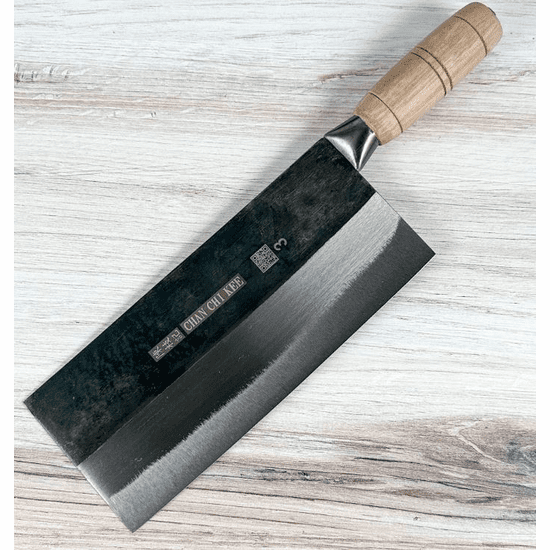
By the way, I do have a hand-made carbon steel knife, created by a young apprentice knifemaker who lives in my valley, Gabriel. I don’t dare use it, it’s far too beautiful. But I’m commissioning a proper to-be-used Chinese chef’s cleaver from him. He wanted a basic design, I found the one at the top of this article, apparently this is the blade that sets the current standard in the Middle Kingdom.
This all sent my mind back to 1978/79, when I was studying physics teaching in London. We often ate at the Chinese restaurants in Soho, they were legendary and surprisingly cheap.
At the time, though, there was some huge feud running through the kitchens of this district. The bodies of at least two cooks were found in the streets of Soho late at night, hacked to death with kitchen cleavers. The police said openly, we have no chance of solving these murders, this is a totally opaque world for us. I can’t find a single word about these events online but it was quite a big issue at the time. Here you have a famous tourist site right in the middle of London, and open and very bloody gang warfare in the streets.
Every time we went through Chinatown after that, I wondered what really went on in those kitchens. Sometimes it’s better not to know.